Automatic Pre-Brazing Surface Preparation Line
For Towel Radiators & Steel Tube Assemblies

Towel radiator, model 1200 × 500 mm — the product processed on this line
1. Product Overview
This is a complete automatic surface preparation line for steel towel radiators, installed upstream of the brazing furnace. It removes oil, rust and mill scale from the steel elements — collectors and tubes — before brazing paste is applied and the radiator is brazed.
Unlike a powder coating line, this system performs no painting. Its purpose is to deliver a chemically clean, fully dried, chloride-free surface so that the brazing filler metal wets the base metal completely and the joint is free of porosity.
Key design decision — elements are treated before assembly
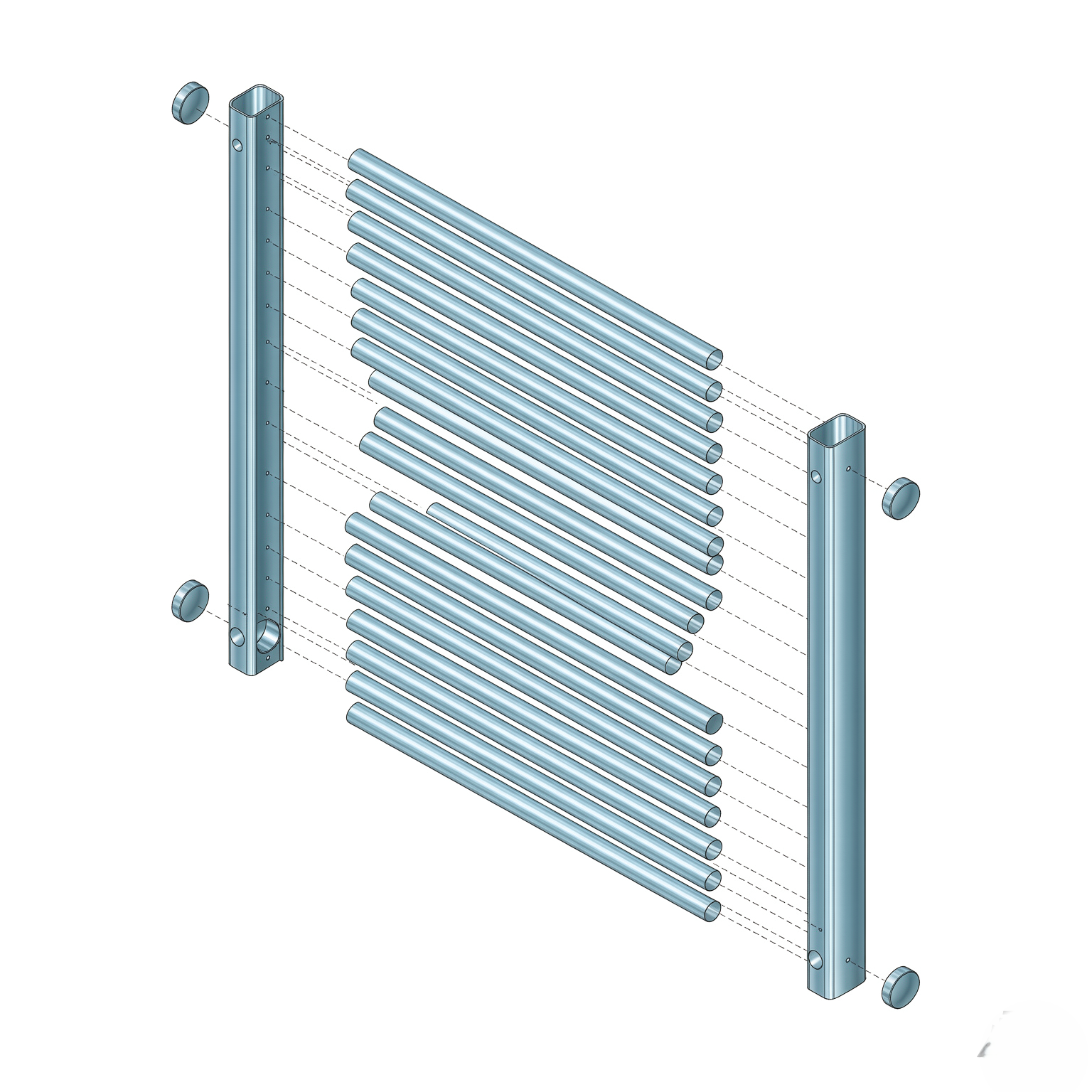
The line processes the individual elements (2 semi-oval collectors + 26 round tubes per radiator) rather than the assembled radiator. This brings three advantages:
· Far shorter line — the tunnel cross-section is set by an element, not by a 1200 mm assembly;
· Higher cleaning efficiency — solutions reach every surface, including the inside of hollow profiles;
· Flexible dwell times — tubes (light rust) and collectors (moderate to heavy rust) can be given different treatment times in the same line.
Typical line configuration
Automatic hoist basket immersion line. Elements are loaded flat into baskets, and a programmable overhead hoist transfers each basket through the tank sequence, giving each basket its own dwell time in every stage.
2. Technical Specifications
Figures below are for the reference project (100 radiators/hour). Every value is engineered to order.
|
Parameter
|
Specification
|
|
Product
|
Towel radiator, model 1200 × 500 mm (other sizes on request)
|
|
Workpiece
|
Steel elements: semi-oval collectors 40 × 30 mm, round tubes Ø25 mm
|
|
Material
|
S235JR steel, 2.0 mm wall thickness
|
|
Max. element length
|
1,800 mm
|
|
Elements per radiator
|
2 collectors + 26 tubes = 28 pieces (+ 4 end caps)
|
|
Weight per radiator
|
19.6 kg
|
|
Capacity
|
100 radiators/hour = 200 collectors + 2,600 tubes = 2,800 elements/hour
|
|
Steel throughput
|
Approx. 1.96 t/hour
|
|
Line type
|
Automatic hoist basket immersion line
|
|
Tank internal size
|
Approx. 2,200 × 1,100 × 800 mm (approx. 1.6 m³ of solution)
|
|
Basket capacity
|
10 radiators per basket (280 elements, approx. 196 kg)
|
|
Heating source
|
Electric or natural gas (both options available)
|
|
Installed power
|
Approx. 200 kW (all-electric) / approx. 105 kW + 12 m³/h natural gas
|
|
Voltage
|
Designed for 400 V / 50 Hz three-phase (other standards on request)
|
|
Control
|
PLC + touchscreen HMI, automatic hoist sequencing, recipe storage
|
|
Tank material
|
PP / FRP for acid stages; stainless steel for alkaline stages
|
|
Heat exchanger
|
PTFE or graphite for hydrochloric acid; stainless steel for phosphoric acid
|
|
Exhaust
|
Acid mist extraction with scrubber
|
|
Effluent
|
Neutralisation station (supplied or prepared by customer)
|
3. Process Sequence

Process flow: degreasing → rinsing → pickling → rinsing → neutralising → DI rinsing → drying → brazing
|
#
|
Stage
|
Method
|
Temperature
|
Dwell time
|
Purpose
|
|
1
|
Degreasing
|
Immersion
|
40–60 °C
|
3–5 min
|
Removes drawing oil, grease and shop soil
|
|
2
|
Rinse 1
|
Immersion
|
Ambient
|
1 min
|
Removes alkaline residue before the acid stage
|
|
3
|
Pickling
|
Immersion
|
25–40 °C
|
3–8 min
|
Dissolves rust and mill scale; dwell set per element type
|
|
4
|
Rinse 2
|
Immersion, counter-flow
|
Ambient
|
1 min
|
Removes acid residue
|
|
5
|
Neutralising
|
Immersion
|
40 °C
|
1–2 min
|
Mild alkaline rinse; removes chloride residue, prevents flash rust
|
|
6
|
DI final rinse
|
Immersion
|
Ambient
|
1 min
|
Deionised water; conductivity monitored online
|
|
7
|
Drip + air knife
|
Blower
|
Ambient
|
2–3 min
|
Removes bulk water; cuts drying energy by approx. 30%
|
|
8
|
Drying
|
Hot-air oven
|
100–130 °C
|
10–15 min
|
Complete drying — no water may enter the brazing furnace
|
After the line: brazing paste is applied immediately, then the assembly enters the brazing furnace.
3.1 Why each step matters for brazing quality
· Oil left on the surface blocks wetting of the filler metal — degreasing is not optional;
· Chloride residue from hydrochloric pickling must be fully removed, or the joint will be defective;
· Water trapped inside the tubes or collectors turns to steam inside the brazing furnace and causes porosity — which is why drip zones and complete drying are designed in, not added as an afterthought;
· Bare steel can flash-rust within hours, so drying must be complete and paste applied right after the line.
4. Element Handling
Element breakdown | Basket with tilt
Element breakdown (model 1200 × 500)
|
Element
|
Specification
|
Qty per radiator
|
Unit weight
|
|
Collector
|
Semi-oval 40 × 30 mm, length 1,200 mm (up to 1,800 mm)
|
2
|
2.25 kg
|
|
Tube
|
Round Ø25 mm, length 470 mm, arranged 5 / 9 / 12
|
26
|
0.58 kg
|
|
End cap
|
Ø10 × 24 mm
|
4
|
—
|
|
Total
|
S235JR steel, 2.0 mm
|
28 + 4
|
19.6 kg
|
Basket and rack design
· Elements are laid flat in baskets, not hung vertically. At 1,800 mm a vertical tank would need to be about 2.4 m deep; a flat basket needs only about 0.8 m.
· Baskets hold the elements at an angle of roughly 10–15° so that solution enters and drains completely from the hollow profiles.
· Oscillation and tank circulation can be added to renew solution inside the collectors — this is what actually removes rust from the inside, not longer immersion time.
· Different baskets can be assigned different dwell times by the hoist programme, so tubes and collectors are each treated exactly as long as they need.
5. Line Layout

Automatic hoist basket immersion line — tank sequence with overhead hoist and final drying oven
Layout principles applied
· One-way material flow — load at one end, unload at the other, no backtracking;
· Isolation zones between chemical stages prevent cross-contamination: alkaline carried into the acid tank neutralises it, acid carried into a rinse tank causes flash rust;
· Counter-flow rinsing — fresh water enters at the final rinse and overflows backwards, cutting water consumption to approximately 0.8–1.5 m³/h;
· Straight, U-shaped or L-shaped layouts available to suit the available floor area;
· Maintenance access, FRP walkways and inspection doors designed into every tank.
Utilities required (reference project)
|
Utility
|
Requirement
|
|
Electrical power
|
Approx. 200 kW installed (all-electric) or approx. 105 kW with gas-fired dryer
|
|
Natural gas
|
Approx. 12 m³/h (gas-fired drying oven option)
|
|
Water make-up
|
0.8–1.5 m³/h, counter-flow rinsing
|
|
Deionised water
|
Approx. 0.3 m³/h for the final rinse
|
|
Compressed air
|
6–8 bar, instrumentation only (air knife uses a blower, not compressed air)
|
|
Exhaust
|
Acid mist extraction to scrubber
|
|
Effluent
|
Neutralisation of spent pickling liquor and rinse water
|
|
Clear height
|
Approx. 4.5 m minimum for the hoist line
|
6. Result

Steel elements before and after the pre-brazing treatment — rust removed, bright metal exposed
|
Aspect
|
Result
|
|
Surface condition
|
Free of oil, rust, mill scale and chloride residue
|
|
Internal cavities
|
Reached and drained by design — basket tilt plus optional circulation
|
|
Drying
|
Complete; no trapped water entering the brazing furnace
|
|
Final rinse control
|
Online conductivity monitoring with alarm limit
|
|
Flexibility
|
Separate dwell times for tubes and collectors; adjustable to the incoming rust level
|
|
Chemistry
|
Runs on the customer's locally supplied chemicals, or equivalent CoatTech chemistry
|
7. Project Reference
|
Item
|
Detail
|
|
Client
|
A leading steel tube and section manufacturer in Algeria
|
|
Industry
|
Steel tube production, towel radiator manufacturing
|
|
Location
|
Boudouaou, Algeria
|
|
Application
|
Surface preparation of collectors and tubes before brazing
|
|
Capacity
|
100 radiators per hour
|
|
Scope
|
Process design, equipment supply, layout, commissioning support
|
|
Status
|
Engineering proposal stage
|
Note for publication: confirm with the client before publishing their company name. If approval is not obtained, use the wording above.
7.1 What the client asked for
· Treatment of elements before assembly, to shorten the line and increase cleaning efficiency;
· Different dwell times for lightly rusted tubes and heavily rusted collectors;
· Racks or baskets that let solution reach and drain from the inside of hollow profiles;
· Conductivity monitoring of the final rinse with a defined limit, before brazing paste is applied;
· The immersion option kept in the offer for the pickling stage.
8. Why CoatTech
|
Advantage
|
Description
|
|
Process first, equipment second
|
We size the line from the chemistry and the rust level, not from a catalogue
|
|
Corrosion-resistant construction
|
PP / FRP tanks and PTFE or graphite heat exchangers for hydrochloric acid; SUS304 / SUS316 for alkaline and phosphoric stages
|
|
Complete drying design
|
Air knife blow-off before the dryer, cutting drying energy by roughly 30%
|
|
Traceable rinse quality
|
Counter-flow rinsing with online conductivity monitoring on the final rinse
|
|
Flexible line control
|
Hoist-programmed dwell times per basket — different recipes for different elements or rust levels
|
|
Local chemistry compatible
|
Designed to run on chemicals already available in the customer's market
|
|
Energy options
|
Electric or natural gas heating, quoted side by side so you can compare operating cost
|
|
Export experience
|
Projects delivered across Africa, the Middle East, Europe and Asia; CE documentation and French-language technical files available
|
|
Payment terms
|
Irrevocable letters of credit accepted for African projects
|
9. Applications
The same line concept is used for any steel assembly that is brazed, welded or coated and needs a chemically clean surface beforehand:
· Towel radiators and heating radiators — collectors, tubes and headers before brazing;
· Steel tube assemblies — furniture frames, heat exchangers, condenser coils;
· Automotive and HVAC components — tube-and-header assemblies before brazing;
· General steel fabrications — as the pretreatment stage ahead of powder coating or liquid painting.
10. Frequently Asked Questions
Q: Is this a powder coating line?
No. It is a pre-brazing surface preparation line. It cleans and dries the steel elements; no powder or paint is applied. If you also need a powder coating line after brazing, we design and supply that as a separate line.
Q: Spray tunnel or immersion tanks — which do you recommend?
For this application we recommend immersion. Heavy rust on the collectors needs minutes of contact, and the inside of the hollow profiles must be wetted — spray cannot do either reliably. We can quote a spray version for comparison.
Q: Does immersion mean electrolytic immersion?
No. We mean simple chemical dipping with no electric current. Electrolytic immersion needs a rectifier and electrodes, costs significantly more, and we do not recommend it as the base design.
Q: Can tubes and collectors have different treatment times?
Yes. That is a standard feature of a hoist line — the programme assigns a dwell time to each basket, so tubes and collectors are each treated exactly as long as they need.
Q: How do you stop rust remaining inside the collectors?
Baskets hold the elements at an angle so solution enters and drains, and we offer tank circulation and basket oscillation to renew the solution inside the profile. Longer immersion alone does not solve it.
Q: Which acid should we use — hydrochloric or phosphoric?
Both work. With hydrochloric acid the tanks must be PP or FRP and the heat exchangers PTFE or graphite — stainless steel cannot be used. Phosphoric acid allows stainless steel tanks and leaves a light anti-rust film. We will quote to your preference.
Q: What utilities does the line need?
For the reference project: approximately 200 kW installed power (or about 105 kW with a gas-fired dryer plus roughly 12 m³/h of natural gas), 0.8–1.5 m³/h of water make-up, deionised water for the final rinse, 6–8 bar compressed air for instrumentation, and acid mist extraction with a scrubber.
Q: Can the line run on chemicals we already buy locally?
Yes. We design the line around your existing products and parameters. We can also supply equivalent chemistry if you prefer.
Q: Do you supply the fume scrubber and effluent neutralisation?
Both are available. We will supply them if required, or design the connection points and let your local contractor build them — whichever you prefer.
Q: What is the delivery time?
Typically 8–14 weeks from order to delivery, depending on the configuration, plus installation and commissioning. We will state a firm schedule with the quotation.
Q: Do you provide installation and training?
Yes. We provide installation supervision, commissioning and operator training, and we can quote either as a separate item or included in the package.


Product Tags:

|
|
Automatic Pre-Brazing Surface Preparation Line Images
|